
Bowing Basement Wall Repair in Winnipeg
A wall curving inward is carrying pressure it was not built for, and it does not recover on its own.
A basement wall is designed to hold back soil, but only up to the pressure it was built for. When saturated clay expands against it, that pressure can exceed what the wall can carry, and the wall responds by curving inward.
This is the failure mode Winnipeg Foundation Experts treats with the most urgency, because unlike a shrinkage crack it does not stabilise on its own.
Recognising It
Bowing is easier to feel than to see. Hold a long straight edge vertically against the wall and the gap in the middle tells you more than looking at it does. In block walls the giveaway is a horizontal crack running along a mortar joint partway up the wall, often around the midpoint.
Other signs are the top of the wall pushing in at the joist line, stair-step cracking angling up toward the corners, and a wall that appears to lean into the room at the top.
What We Do About It
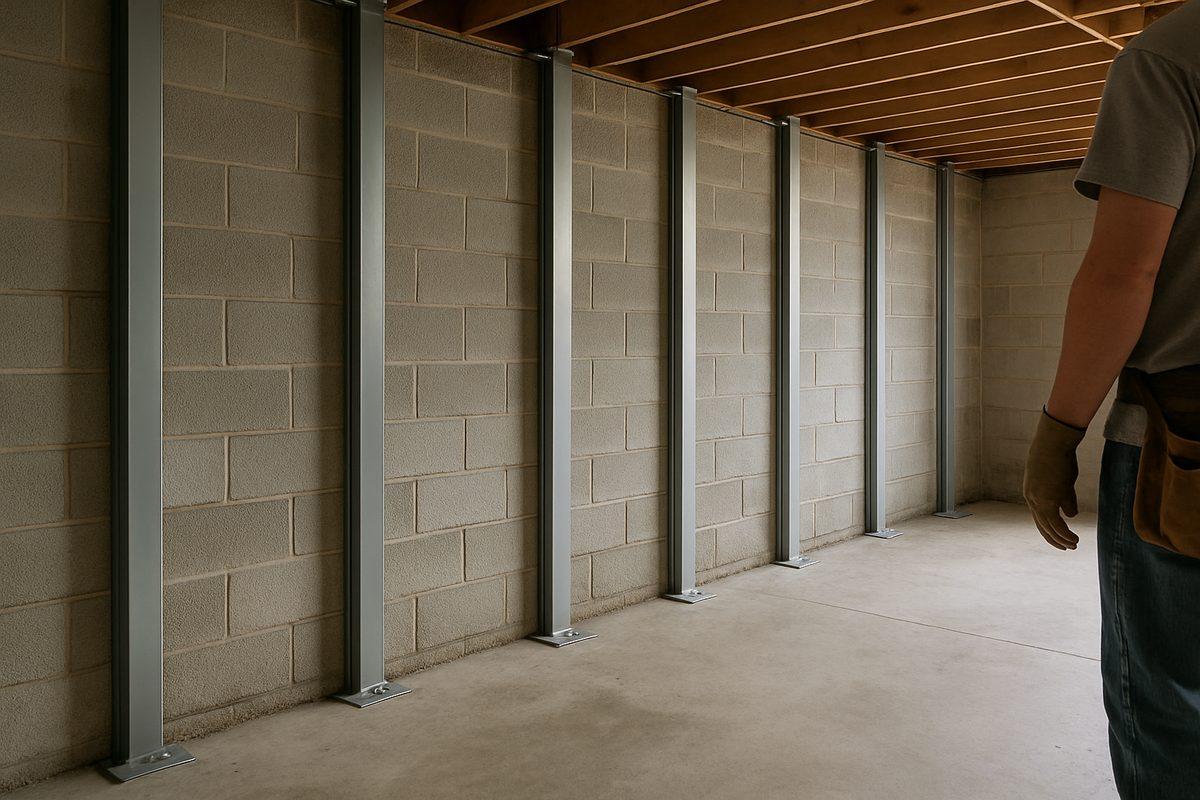
Steel bracing is the most common repair. Vertical I-beams are set against the wall at intervals, anchored into the floor slab and secured to the floor joists overhead. The beams take the load the wall can no longer carry.
Carbon fibre straps suit walls caught early, where movement is limited. They are bonded to the wall face and resist further inward deflection without occupying floor space, which matters in a finished basement.
Wall anchors work where there is exterior access. Plates are set in stable soil away from the house and connected through the wall by rods. They can be tightened over time, which offers some prospect of pulling the wall back rather than only holding it.
Fixing the Cause, Not Just the Wall
Bracing a wall without addressing the water that is loading it means the pressure keeps building against a reinforced wall. That is better than an unreinforced one, but it is half a repair.
So we look at drainage as part of this work. Where downspouts discharge, how the grade sits against the house, whether the weeping tile is functioning. Reducing the water in the soil reduces the pressure on the wall, and it is usually the least expensive part of the job.
Why This Is Common Here
Winnipeg’s clay expands substantially when it takes on water, and frost drives well below footing depth through the winter. Both push against basement walls. Houses with block foundations and original drainage are the ones we see this on most often.
If you have a horizontal crack or a wall that looks like it is curving, have it looked at sooner rather than later. The assessment is free. Related: foundation crack repair for the cracking itself, basement waterproofing to reduce the pressure, and foundation piling where the footing is also moving. We work across East Kildonan and St. Boniface, where older block foundations are widespread.
What's Included
- Steel I-beam bracing anchored to floor and joists
- Carbon fibre straps for walls at an early stage of movement
- Wall anchors where exterior access allows
- Drainage correction to remove the pressure causing it
- Written scope before work starts
Other Services We Offer in Winnipeg
Bowing & Bulging Wall Repair Questions
How much bowing is too much?
Any measurable inward curve in a basement wall is worth assessing, and the rate of change matters more than the amount. A wall that has moved slightly and stayed put for a decade is a different situation from one that has moved recently. We measure it and tell you which you have.
What causes a wall to bow inward?
Lateral pressure from the soil outside. Saturated clay expands and pushes, and frost adds to it. Block walls are more vulnerable than poured concrete because the mortar joints are the weak line, which is why bowing block often shows a horizontal crack partway up.
Can a bowed wall be straightened, or only stopped?
It depends on the method and how far it has gone. Wall anchors can recover some movement over time by tensioning against soil outside. Steel bracing and carbon fibre are primarily about stopping further movement. We will tell you which outcome is realistic before you decide.
Is a horizontal crack serious?
It is the crack pattern we treat most seriously. A horizontal crack across a basement wall usually means the wall is being pushed inward rather than settling downward, and unlike most vertical cracking it tends to get worse rather than stabilise.
Get a Free Bowing & Bulging Wall Repair Quote
Book a free assessment. We will tell you what is moving, why, and whether it needs work now.